
Evidence Review · The Journal
Massage for low-back pain: what it does, what it doesn't
The NCCIH summary, the 2017 guideline that lists massage for acute low-back pain, the difference between acute and chronic — and which session on our menu fits each one.
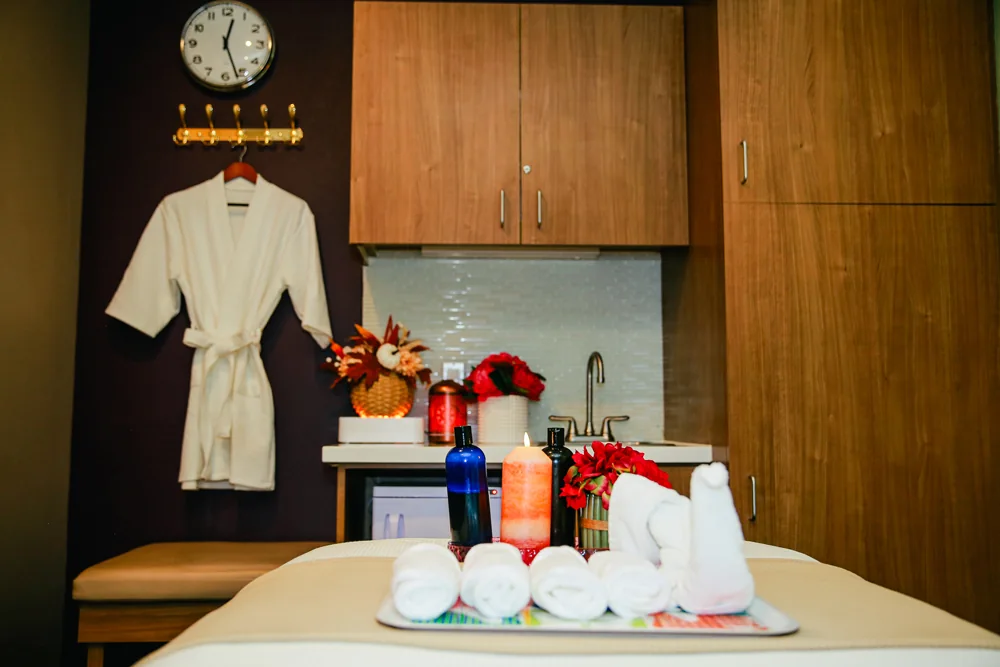
Massage for lower back pain works about the way the honest research says it does: it can bring short-term relief, the evidence behind that relief is weak, and it isn't a cure. In practice that means 60 minutes on the table — the $100 Signature Massage with a low-back focus — not a miracle. The National Center for Complementary and Integrative Health reports that in both acute and chronic low-back pain there were short-term improvements in pain after massage therapy, and that the American College of Physicians' 2017 clinical guidelines included massage as an option for acute and subacute low-back pain — but not among the options for chronic low-back pain. That's the whole story in two sentences. The rest of this page is what to do with it.
Lower back pain is the single most common thing people walk in here with. Not injuries — people with injuries are at the doctor, where they should be. The everyday version: the low back that's tight by Thursday, stiff after the drive in from Calabasas, sore after a weekend of yard work or a long hike. For that, a well-aimed hour on the table is genuinely useful. We just won't oversell what "useful" means.
What the research actually says
NCCIH's summary of the evidence on massage for low-back pain is unusually plain-spoken, so it's worth quoting rather than paraphrasing. "Several evaluations of massage for low-back pain have found only weak evidence that it may be helpful." A review found "evidence that massage was helpful for chronic low-back pain but the strength of the evidence was low." Another found that "in both acute and chronic low-back pain, there were short-term improvements in pain after massage therapy" — while its authors had "very little confidence" that massage is an effective treatment. And then the guideline line: the American College of Physicians in 2017 "included massage therapy as an option for treating acute/subacute low-back pain but did not include massage therapy among the options for treating chronic low-back pain."
Read that twice, because both halves matter. Massage shows up in a real clinical guideline for the first weeks of a back episode. It does not show up for the long-haul kind. And even where it does help, the help is measured in days, not months.
NCCIH's separate overview of chronic pain compresses the same thing into one sentence: the ACP guideline "recommends massage as an option for acute low-back pain, based on low-quality evidence, but does not recommend massage for chronic low-back pain." Among people with diagnosed chronic pain, it adds, the most frequent conditions are low-back pain and osteoarthritis — so you're in a very large club.
“A massage can make a bad week better. It can't make a bad back good.”
Acute, subacute, chronic — why the label changes what you book
NINDS, the neurology institute at NIH, draws the line this way: acute pain "starts suddenly and ends when its cause is treated or healed," while chronic pain "lasts for longer than three months or the expected healing time." Chronic low back pain, NINDS notes, is one of the textbook examples of pain that can persist without an obvious ongoing cause — which is part of why the guideline treats it differently. Here's how that maps onto a massage menu:
| Phase | What the sources say | What we'd suggest |
|---|---|---|
| Acute — the first few weeks | ACP lists massage as an option. NCCIH: short-term pain improvement. | Gentler Swedish-style 60-minute Signature ($100), hips and glutes first. If it's sharp or started with an injury, see a doctor before you see us. |
| Subacute — the weeks after that | Still inside the window where ACP lists massage. | 60 or 90 minutes ($100 / $168) with a low-back focus; deep tissue if the sharpness has faded and what's left is tightness. |
| Chronic — past about three months | NCCIH: short-term improvements, low-strength evidence. ACP didn't list massage. | Use massage as comfort alongside whatever your clinician recommends — not instead of it. A regular rhythm beats a heroic one-off. |
- What the sources say
- ACP lists massage as an option. NCCIH: short-term pain improvement.
- What we'd suggest
- Gentler Swedish-style 60-minute Signature ($100), hips and glutes first. If it's sharp or started with an injury, see a doctor before you see us.
- What the sources say
- Still inside the window where ACP lists massage.
- What we'd suggest
- 60 or 90 minutes ($100 / $168) with a low-back focus; deep tissue if the sharpness has faded and what's left is tightness.
- What the sources say
- NCCIH: short-term improvements, low-strength evidence. ACP didn't list massage.
- What we'd suggest
- Use massage as comfort alongside whatever your clinician recommends — not instead of it. A regular rhythm beats a heroic one-off.
A good deep-tissue massage can fix a bad lower back.
No. The best reading of the evidence — NCCIH's — is short-term pain improvement with weak evidence, and no place in the chronic-pain guideline. Massage lives in the "feel better this week" column, not the "fixed" column.
Harder pressure means more relief.
Nothing in the reviews NCCIH summarizes ranks pressure. What they measured was pain afterward. A session you can breathe through, aimed at the right muscles, is what we'd bet on — not one you have to survive.
What a low-back session looks like here
People expect us to go straight at the sore spot. We mostly don't, at least not first. In our experience, a lot of what feels like a low-back problem is held in the hips and the glutes, and working there before the back itself usually gets further. The shape of the hour:
-
Say it at minute one
Where it hurts, how long, what makes it worse, whether a doctor has seen it. Thirty seconds of this changes the whole hour. -
Warm-up
Long Swedish strokes down the back and legs. Nobody digs into a cold muscle. -
Hips and glutes
The part most people didn't come in for and leave talking about. Deep, slow work through the glutes and the outer hip. -
The low back itself
Once the surrounding tissue has let go — pressure set by you, adjusted whenever you say. We never work directly on the spine. -
Afterward
Water, and keep moving. NINDS notes that regular exercise can help prevent low back pain and reduce how much it gets in the way of daily life — advice no massage replaces.
Which session on the menu fits a sore back
- The 60-minute Signature ($100). Deep tissue or Swedish, essential oil, with a low-back focus if you ask for it. Enough time for hips, glutes, and the back. The default.
- The 90 ($168). When the back has company — tight hamstrings, a locked-up mid-back, shoulders. Ninety minutes lets the therapist stay somewhere instead of visiting.
- Cupping, added or built in. A 20-minute add-on ($40) onto any massage, or the 80-minute Cupping Therapy Massage ($196). Comfort, not treatment — see the FAQ.
- Hot stone + gua sha scraping ($196). For the cold, stiff, "set in concrete" back more than the acutely sore one. Heat first, then the scrape along the muscles beside the spine.
- iRelaxbot Spinal Harmony — 50 minutes ($75). Our robotic bed's program built around the back and spine: steady, even pressure, no hands, no conversation. A fair pick if you'd rather not be touched, or if every therapist is booked. We don't claim it treats back pain; we claim it feels good on a stiff one.
On pressure, soreness, and the day after
You may be a little tender the day after a deep low-back session. That's normal, and it fades. What isn't normal is pain that's worse than when you walked in, and if that happens we want to hear about it. The American Massage Therapy Association's position is that massage can help with stress and tension and support general wellness — which is a deliberately modest claim, and the right one. Many California cities require massage professionals to be CAMTC-certified (California Massage Therapy Council) — you're welcome to ask about your therapist's credentials when you book.
If the back is the reason you're reading this, the short version: book the 60-minute Signature, say "low back" when you reserve, and let the therapist start where the problem usually lives. We're at 5871 Kanan Rd, Agoura Hills, CA 91301, open every day 10 AM to 9 PM, with online booking through Fresha or a phone call to (818) 540-8060.